


Denver to Vail Limo | Complete Transfer Guide
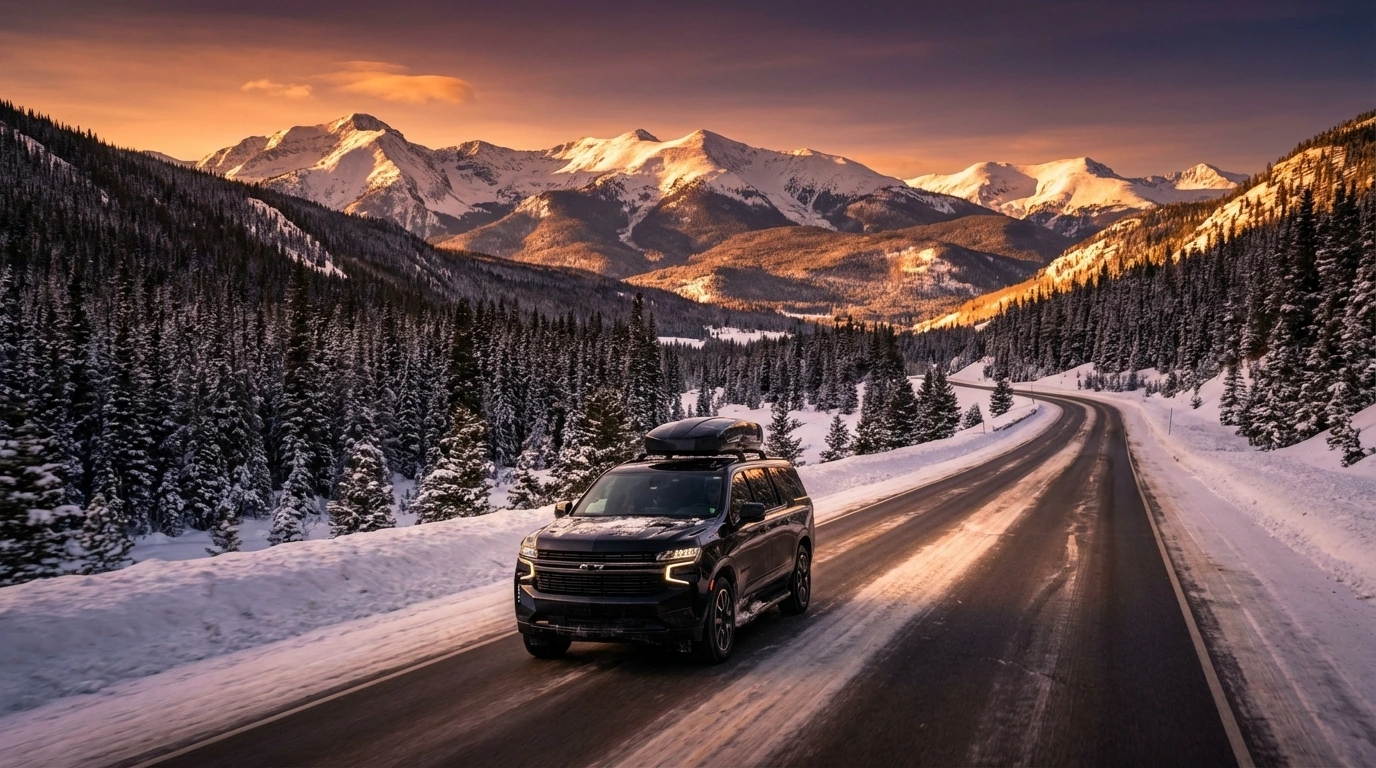
TL;DR: Denver International Airport (DEN) sits 119.6 miles from Vail via I-70 West, roughly 2 hours in ideal conditions. In ski season, the same corridor can take 3 hours or more. Uber and Lyft aren’t designed for a 100-mile mountain transfer. Shared shuttles tie you to a fixed departure schedule. And self-driving Vail Pass in a blizzard after a cross-country flight is a commitment most guests don’t need. Pre-booking a private chauffeur removes every variable: confirmed vehicle, fixed rate, flight monitoring, and a professional who knows the road in every condition.
The math seems simple. One highway. Just over 100 miles. A straight shot west out of Denver on I-70. Most visitors assume getting from Denver to Vail is the uncomplicated part of the trip.
It isn’t always.
The I-70 corridor between Denver and Vail is the most heavily trafficked mountain road in Colorado. On Friday afternoons during peak ski season, what your GPS estimates at two hours can become four. Vail Pass sits at 10,666 feet. The Eisenhower Tunnel, the highest vehicular tunnel in the world, pushes past 11,000 feet. Winter weather shuts the corridor without warning. CDOT chain laws activate on short notice. And when I-70 backs up between Denver and the mountains, it backs up with nowhere to go.
The travelers who arrive in Vail on time, in good shape, ready to start the trip they paid for, are not the ones who improvised their ground transport after landing. They are the ones who arranged it before they left.
How Far Is Denver from Vail?
Denver International Airport is 119.6 miles from Vail. The entire route runs west on I-70, climbing from Denver’s 5,280-foot elevation through the Front Range foothills, under the Continental Divide via the Eisenhower Tunnel at 11,013 feet, and down through the Eagle River Valley to Vail at approximately 8,150 feet.
Under normal conditions, the drive takes roughly 2 hours. That estimate applies to light-traffic weekdays outside peak season. In ski season, on Friday afternoons and Saturday mornings, or during any winter event on Vail Pass or near the tunnel, the real-world transfer time ranges from 2.5 to 3.5 hours. Closures and major incidents push the total higher.
The elevation profile matters practically, not just scenically. The road climbs nearly 6,000 feet from the airport and then descends into Vail. Winter conditions on that climb can deteriorate faster than weather apps update. A chauffeur who monitors CDOT alerts in real time and knows the corridor’s seasonal patterns is a qualitatively different experience from any first-time driver navigating the route by GPS.
What the I-70 Drive to Vail Actually Looks Like
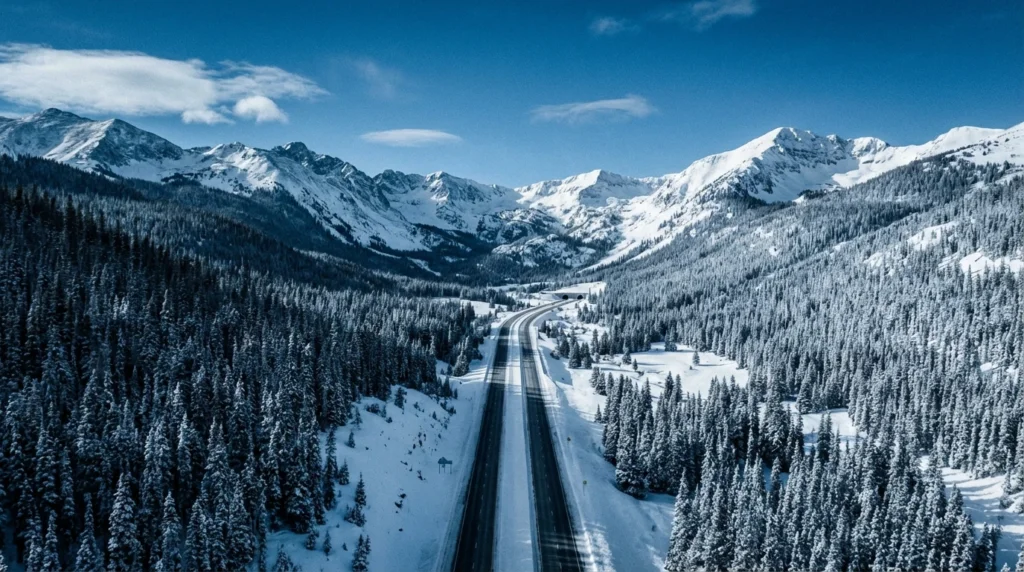
Leaving Denver International Airport, you head west on I-70 through Aurora and into the eastern suburbs before the highway begins its climb into the Rockies. The transition is gradual at first, then abrupt.
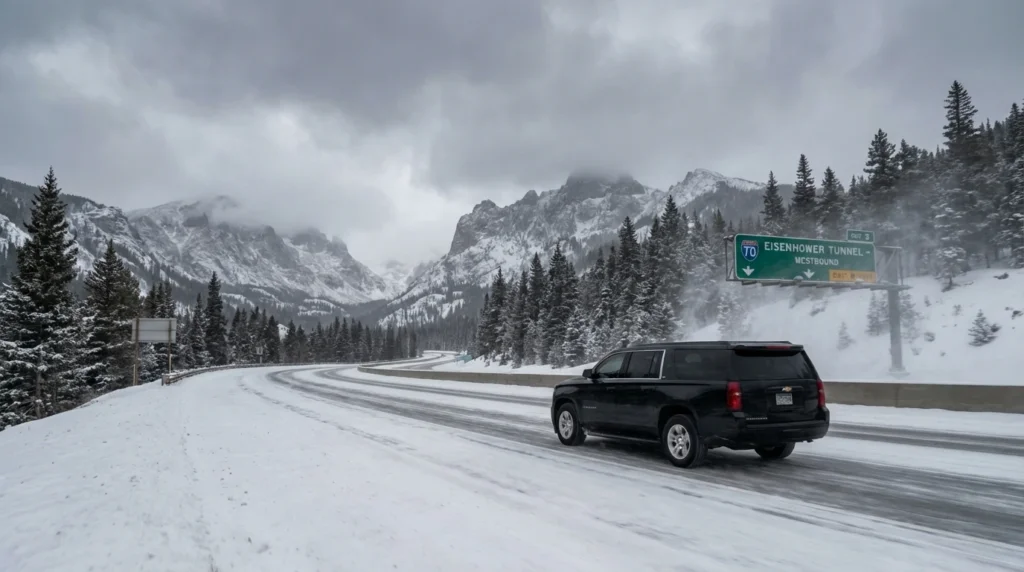
Idaho Springs, a historic mining town at roughly 7,540 feet, sits about 45 miles from the airport and marks the point where the ascent becomes serious. From there, the road climbs steeply toward the Eisenhower Tunnel. The Eisenhower-Johnson Memorial Tunnel carries I-70 under the Continental Divide at 11,013 feet, making it the highest vehicular tunnel in the world. It is one of CDOT’s most actively managed segments and a well-known chokepoint during ski weekends.
After the tunnel, the highway descends into Summit County, passing through Silverthorne and Frisco. Copper Mountain Resort marks the base of the final climb up Vail Pass. Vail Pass stands at 10,666 feet and is subject to closures, chain requirements, and speed restrictions on short notice in winter conditions. Once over the pass, the road follows the Eagle River Valley west into Vail. The main Vail Village exit is Exit 176. Lionshead is Exit 173. Knowing the difference matters when your driver has done the route hundreds of times versus never.
Is Uber or Lyft Available for a Denver to Vail Transfer?
Uber and Lyft both operate in Denver and both technically serve Vail. Whether they are a practical option for a 120-mile mountain transfer in ski season is a different question.
The structural issue is pricing and supply. A Denver-to-Vail Uber trip during peak ski season can price at $200 to $350 or more with surge, depending on demand and time of day. That figure is dynamic: the estimate you see when you request the ride may shift before a driver accepts. There is no guaranteed acceptance, no fixed rate, and no one monitoring your flight.
Drivers completing a 120-mile round trip are committing most of a working day. The pool willing to take that run at any given moment is thin. If your flight lands at 10 p.m. on a Friday in January and you’re competing with other passengers from the same arrival bank, the Uber experience at DEN heading toward Vail looks nothing like a city ride-share.
Lyft has the same constraints. Both apps were built for urban and suburban trips. The Denver to Vail corridor is neither.
What Are Your Ground Transport Options from Denver to Vail?
Several options exist for the Denver to Vail transfer, and each involves trade-offs that matter considerably over a 120-mile mountain route.
Shared shuttle services such as Epic Mountain Express and Resort Express operate scheduled departures between DEN and Vail. They are cost-effective, but they run on their schedule. A delayed flight means a missed shuttle, not a delayed one. Multiple passengers mean multiple stops, and your door-to-door time extends well beyond the base drive. You share the vehicle with other guests and their gear, on a fixed timeline that does not bend for your itinerary.
Rental cars are available at DEN through every major agency, but ski season booking windows are aggressive. Arriving on a busy winter weekend without a reservation frequently means no vehicle is available. If you do secure one, Colorado’s Traction Law requires vehicles on mountain corridors between September 1 and May 31 to meet specific all-wheel-drive and winter tire standards. Not all rental vehicles meet that threshold without verification at the counter.
Driving yourself is a reasonable option for guests who are experienced on Colorado’s mountain highways. Vail Pass demands respect in winter. CDOT can close the road or implement chain requirements without significant advance notice, and an incident in the corridor at 11,000 feet at night after a long flight is a different category of complication. For guests who are comfortable on mountain roads, self-driving works. For everyone else, it is a variable that can be eliminated.
A pre-booked private chauffeur from Express Limo’s Denver to Vail service eliminates every variable at once. The rate is fixed before booking. Your chauffeur monitors your flight and adjusts for delays. The vehicle is AWD-equipped and purpose-maintained for winter mountain conditions. You are delivered to your door in Vail or Beaver Creek, not to a shared shuttle stop two streets away.
Why Pre-Booking a Denver to Vail Limo Matters
On a route this long, through terrain this demanding, the difference between pre-booked and improvised is not only about comfort. It is about reliability.
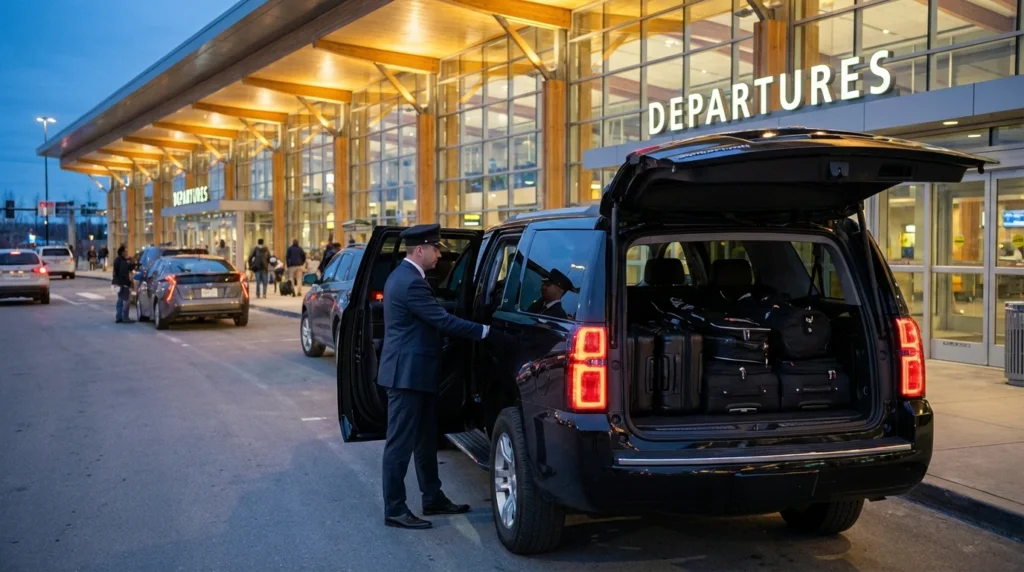
A pre-booked private chauffeur means the vehicle is confirmed before your plane touches down at DEN. Your chauffeur is tracking the flight. If your connection runs long or baggage claim takes extra time, the schedule adjusts. The price agreed at booking is the price paid. There are no surge multipliers at midnight on a January Friday, and no negotiations about whether the driver wants to make the trip at all.
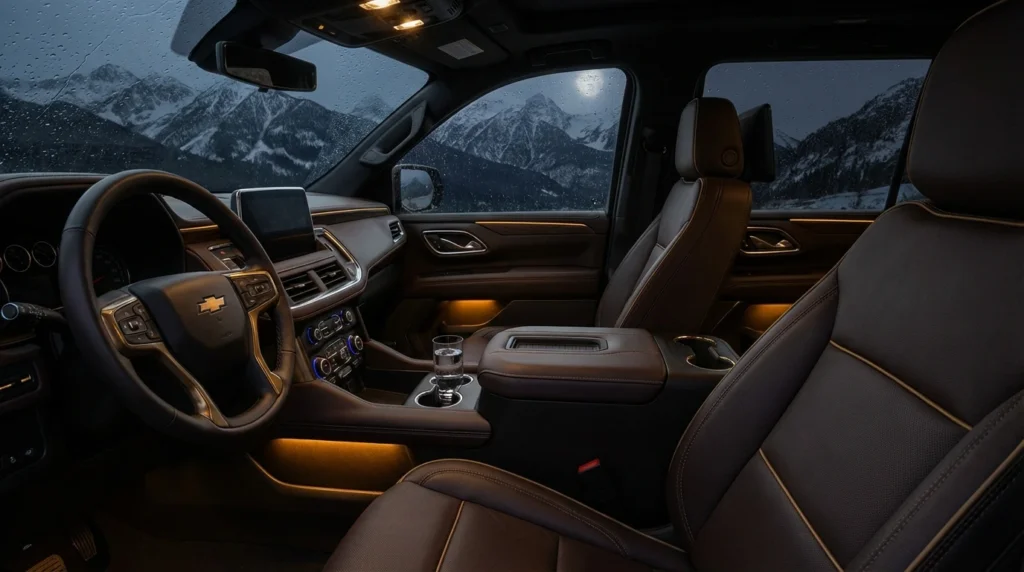
For guests traveling in groups, the economics shift further. A private Chevrolet Suburban or Mercedes-Benz Sprinter from Express Limo’s Vail and Beaver Creek service moves a group from DEN to Vail in a single confirmed vehicle at a fixed rate. Four shuttle tickets or multiple surge-priced Ubers approach the same total cost with none of the certainty.
Vail draws a specific kind of traveler. Guests arriving for a private ski week, attending Taste of Vail (one of the nation’s premier food and wine festivals, held each April), or flying in for a corporate group stay all share one thing: the transfer from Denver is the beginning of an experience worth protecting. How you arrive in Vail sets the tone for everything that follows.
The Smartest Way to Get from Denver to Vail
I-70 West is the only route. There is no shortcut, no alternate highway, and no workaround when the corridor slows. What you control is the quality of your ground transport before you land.
Shared shuttles work well for flexible travelers comfortable with a shared vehicle and a fixed schedule. Rental cars are a sound option for guests confident on Colorado mountain highways in winter. Uber and Lyft are workable fallbacks for off-peak transfers when dynamic pricing and limited availability are acceptable trade-offs.
For guests who have traveled a long way to reach Vail, who are arriving with ski equipment or a group, or who are beginning a trip worth thousands of dollars: a pre-booked private chauffeur is the correct choice. Book your Denver to Vail private transfer before your departure date. The I-70 corridor in ski season does not reward improvisation, and the traveler who arranged the transfer in advance is the one who starts the trip on their own terms.
Frequently Asked Questions
How far is Denver from Vail?
Denver International Airport is 119.6 miles from Vail via I-70 West. The route climbs from 5,280 feet in Denver to over 11,000 feet at the Eisenhower Tunnel, then descends to Vail at approximately 8,150 feet. Under ideal conditions the transfer takes about 2 hours. In ski season with traffic or winter weather, allow 2.5 to 3.5 hours.
How long does the drive from Denver to Vail take?
In ideal conditions, the drive takes approximately 2 hours. In ski season, particularly on Friday afternoons, Saturday mornings, or during any winter storm affecting Vail Pass or the Eisenhower Tunnel, 3 hours is realistic and 3.5 or more is not unusual. CDOT actively manages the I-70 mountain corridor and can impose chain requirements or closures without significant advance notice. A professional chauffeur who monitors real-time road conditions and adjusts routing accordingly removes that uncertainty from your transfer.
Is Uber or Lyft available from Denver to Vail?
Both Uber and Lyft operate on the Denver to Vail route. In practice, surge pricing during peak ski season can push ride-share costs to $200 or more, driver availability for a 120-mile mountain transfer is limited and inconsistent, and there is no fixed rate or flight monitoring. For time-sensitive travel or peak season arrivals, a pre-booked private chauffeur is the more reliable option.
What is the best way to get from Denver to Vail?
A pre-booked private chauffeur is the most reliable option for the Denver to Vail transfer. Epic Mountain Express and Resort Express offer shared shuttles on fixed schedules, and rental cars are available at DEN when inventory allows. Express Limo’s Denver to Vail service provides a confirmed vehicle, fixed rate, flight monitoring, and door-to-door delivery to any Vail or Beaver Creek address.
Does the Denver to Vail drive go through the Eisenhower Tunnel?
Yes. The I-70 route from Denver to Vail passes through the Eisenhower-Johnson Memorial Tunnel, the highest vehicular tunnel in the world at 11,013 feet, carrying traffic under the Continental Divide. The tunnel is a known ski season chokepoint and is actively monitored by CDOT. After the tunnel, the route climbs Vail Pass at 10,666 feet before descending into Vail.
TL;DR: Denver International Airport (DEN) sits 119.6 miles from Vail via I-70 West, roughly 2 hours in ideal conditions. In ski season, the same corridor can take 3 hours or more. Uber and Lyft aren’t designed for a 100-mile mountain transfer. Shared shuttles tie you to a fixed departure schedule. And self-driving Vail Pass in a blizzard after a cross-country flight is a commitment most guests don’t need. Pre-booking a private chauffeur removes every variable: confirmed vehicle, fixed rate, flight monitoring, and a professional who knows the road in every condition.
The math seems simple. One highway. Just over 100 miles. A straight shot west out of Denver on I-70. Most visitors assume getting from Denver to Vail is the uncomplicated part of the trip.
It isn’t always.
The I-70 corridor between Denver and Vail is the most heavily trafficked mountain road in Colorado. On Friday afternoons during peak ski season, what your GPS estimates at two hours can become four. Vail Pass sits at 10,666 feet. The Eisenhower Tunnel, the highest vehicular tunnel in the world, pushes past 11,000 feet. Winter weather shuts the corridor without warning. CDOT chain laws activate on short notice. And when I-70 backs up between Denver and the mountains, it backs up with nowhere to go.
The travelers who arrive in Vail on time, in good shape, ready to start the trip they paid for, are not the ones who improvised their ground transport after landing. They are the ones who arranged it before they left.
How Far Is Denver from Vail?
Denver International Airport is 119.6 miles from Vail. The entire route runs west on I-70, climbing from Denver’s 5,280-foot elevation through the Front Range foothills, under the Continental Divide via the Eisenhower Tunnel at 11,013 feet, and down through the Eagle River Valley to Vail at approximately 8,150 feet.
Under normal conditions, the drive takes roughly 2 hours. That estimate applies to light-traffic weekdays outside peak season. In ski season, on Friday afternoons and Saturday mornings, or during any winter event on Vail Pass or near the tunnel, the real-world transfer time ranges from 2.5 to 3.5 hours. Closures and major incidents push the total higher.
The elevation profile matters practically, not just scenically. The road climbs nearly 6,000 feet from the airport and then descends into Vail. Winter conditions on that climb can deteriorate faster than weather apps update. A chauffeur who monitors CDOT alerts in real time and knows the corridor’s seasonal patterns is a qualitatively different experience from any first-time driver navigating the route by GPS.
What the I-70 Drive to Vail Actually Looks Like
Leaving Denver International Airport, you head west on I-70 through Aurora and into the eastern suburbs before the highway begins its climb into the Rockies. The transition is gradual at first, then abrupt.
Idaho Springs, a historic mining town at roughly 7,540 feet, sits about 45 miles from the airport and marks the point where the ascent becomes serious. From there, the road climbs steeply toward the Eisenhower Tunnel. The Eisenhower-Johnson Memorial Tunnel carries I-70 under the Continental Divide at 11,013 feet, making it the highest vehicular tunnel in the world. It is one of CDOT’s most actively managed segments and a well-known chokepoint during ski weekends.
After the tunnel, the highway descends into Summit County, passing through Silverthorne and Frisco. Copper Mountain Resort marks the base of the final climb up Vail Pass. Vail Pass stands at 10,666 feet and is subject to closures, chain requirements, and speed restrictions on short notice in winter conditions. Once over the pass, the road follows the Eagle River Valley west into Vail. The main Vail Village exit is Exit 176. Lionshead is Exit 173. Knowing the difference matters when your driver has done the route hundreds of times versus never.
Is Uber or Lyft Available for a Denver to Vail Transfer?
Uber and Lyft both operate in Denver and both technically serve Vail. Whether they are a practical option for a 120-mile mountain transfer in ski season is a different question.
The structural issue is pricing and supply. A Denver-to-Vail Uber trip during peak ski season can price at $200 to $350 or more with surge, depending on demand and time of day. That figure is dynamic: the estimate you see when you request the ride may shift before a driver accepts. There is no guaranteed acceptance, no fixed rate, and no one monitoring your flight.
Drivers completing a 120-mile round trip are committing most of a working day. The pool willing to take that run at any given moment is thin. If your flight lands at 10 p.m. on a Friday in January and you’re competing with other passengers from the same arrival bank, the Uber experience at DEN heading toward Vail looks nothing like a city ride-share.
Lyft has the same constraints. Both apps were built for urban and suburban trips. The Denver to Vail corridor is neither.
What Are Your Ground Transport Options from Denver to Vail?
Several options exist for the Denver to Vail transfer, and each involves trade-offs that matter considerably over a 120-mile mountain route.
Shared shuttle services such as Epic Mountain Express and Resort Express operate scheduled departures between DEN and Vail. They are cost-effective, but they run on their schedule. A delayed flight means a missed shuttle, not a delayed one. Multiple passengers mean multiple stops, and your door-to-door time extends well beyond the base drive. You share the vehicle with other guests and their gear, on a fixed timeline that does not bend for your itinerary.
Rental cars are available at DEN through every major agency, but ski season booking windows are aggressive. Arriving on a busy winter weekend without a reservation frequently means no vehicle is available. If you do secure one, Colorado’s Traction Law requires vehicles on mountain corridors between September 1 and May 31 to meet specific all-wheel-drive and winter tire standards. Not all rental vehicles meet that threshold without verification at the counter.
Driving yourself is a reasonable option for guests who are experienced on Colorado’s mountain highways. Vail Pass demands respect in winter. CDOT can close the road or implement chain requirements without significant advance notice, and an incident in the corridor at 11,000 feet at night after a long flight is a different category of complication. For guests who are comfortable on mountain roads, self-driving works. For everyone else, it is a variable that can be eliminated.
A pre-booked private chauffeur from Express Limo’s Denver to Vail service eliminates every variable at once. The rate is fixed before booking. Your chauffeur monitors your flight and adjusts for delays. The vehicle is AWD-equipped and purpose-maintained for winter mountain conditions. You are delivered to your door in Vail or Beaver Creek, not to a shared shuttle stop two streets away.
Why Pre-Booking a Denver to Vail Limo Matters
On a route this long, through terrain this demanding, the difference between pre-booked and improvised is not only about comfort. It is about reliability.
A pre-booked private chauffeur means the vehicle is confirmed before your plane touches down at DEN. Your chauffeur is tracking the flight. If your connection runs long or baggage claim takes extra time, the schedule adjusts. The price agreed at booking is the price paid. There are no surge multipliers at midnight on a January Friday, and no negotiations about whether the driver wants to make the trip at all.
For guests traveling in groups, the economics shift further. A private Chevrolet Suburban or Mercedes-Benz Sprinter from Express Limo’s Vail and Beaver Creek service moves a group from DEN to Vail in a single confirmed vehicle at a fixed rate. Four shuttle tickets or multiple surge-priced Ubers approach the same total cost with none of the certainty.
Vail draws a specific kind of traveler. Guests arriving for a private ski week, attending Taste of Vail (one of the nation’s premier food and wine festivals, held each April), or flying in for a corporate group stay all share one thing: the transfer from Denver is the beginning of an experience worth protecting. How you arrive in Vail sets the tone for everything that follows.
The Smartest Way to Get from Denver to Vail
I-70 West is the only route. There is no shortcut, no alternate highway, and no workaround when the corridor slows. What you control is the quality of your ground transport before you land.
Shared shuttles work well for flexible travelers comfortable with a shared vehicle and a fixed schedule. Rental cars are a sound option for guests confident on Colorado mountain highways in winter. Uber and Lyft are workable fallbacks for off-peak transfers when dynamic pricing and limited availability are acceptable trade-offs.
For guests who have traveled a long way to reach Vail, who are arriving with ski equipment or a group, or who are beginning a trip worth thousands of dollars: a pre-booked private chauffeur is the correct choice. Book your Denver to Vail private transfer before your departure date. The I-70 corridor in ski season does not reward improvisation, and the traveler who arranged the transfer in advance is the one who starts the trip on their own terms.
Frequently Asked Questions
How far is Denver from Vail?
Denver International Airport is 119.6 miles from Vail via I-70 West. The route climbs from 5,280 feet in Denver to over 11,000 feet at the Eisenhower Tunnel, then descends to Vail at approximately 8,150 feet. Under ideal conditions the transfer takes about 2 hours. In ski season with traffic or winter weather, allow 2.5 to 3.5 hours.
How long does the drive from Denver to Vail take?
In ideal conditions, the drive takes approximately 2 hours. In ski season, particularly on Friday afternoons, Saturday mornings, or during any winter storm affecting Vail Pass or the Eisenhower Tunnel, 3 hours is realistic and 3.5 or more is not unusual. CDOT actively manages the I-70 mountain corridor and can impose chain requirements or closures without significant advance notice. A professional chauffeur who monitors real-time road conditions and adjusts routing accordingly removes that uncertainty from your transfer.
Is Uber or Lyft available from Denver to Vail?
Both Uber and Lyft operate on the Denver to Vail route. In practice, surge pricing during peak ski season can push ride-share costs to $200 or more, driver availability for a 120-mile mountain transfer is limited and inconsistent, and there is no fixed rate or flight monitoring. For time-sensitive travel or peak season arrivals, a pre-booked private chauffeur is the more reliable option.
What is the best way to get from Denver to Vail?
A pre-booked private chauffeur is the most reliable option for the Denver to Vail transfer. Epic Mountain Express and Resort Express offer shared shuttles on fixed schedules, and rental cars are available at DEN when inventory allows. Express Limo’s Denver to Vail service provides a confirmed vehicle, fixed rate, flight monitoring, and door-to-door delivery to any Vail or Beaver Creek address.
Does the Denver to Vail drive go through the Eisenhower Tunnel?
Yes. The I-70 route from Denver to Vail passes through the Eisenhower-Johnson Memorial Tunnel, the highest vehicular tunnel in the world at 11,013 feet, carrying traffic under the Continental Divide. The tunnel is a known ski season chokepoint and is actively monitored by CDOT. After the tunnel, the route climbs Vail Pass at 10,666 feet before descending into Vail.
Ready to Experience Luxury Transportation?
Book your premium ride with Express Limo Vail and travel in style.
Book Your Ride